

Lately I’ve been evaluating tons of freelance writers, reading lots of blog post, editing so many pieces, and helping multiple new writers understand how to write a good blog post. The question: “how I write a blog post”, “What does the process look like from start to finish? where in the process I do specific things?”; are always asked me by my students.
In this article I’ll be answering those questions as well as taking you through exactly what I do so you can do the same (or choose your own unique twist) to creating content much easier.
Blogging has become an important aspect of any business. Many companies have a blog on their website where users can read content related to the industry. Having a blog on your website is a great way to drive traffic, expand your audience, and connect with your customers. And if they are interested in your blog, they’re more likely to engage with and support your business growth.
What is a blog post?
A blog post is an informational article or entry published on a blog/website (short for “weblog”). A blog post can include written content, photos, videos, or a combination of the three. (short for “weblog”). Unlike static website pages, blog posts are regularly updated, usually organized by topic or category, and typically feature an informal, conversational tone to directly engage readers. These pieces of content typically range in length from several hundred words to a few thousand words. In a blog post, a writer will share their views on a particular subject to entertain, educate or inform their readers. the tone of the content is depending on the topic and brand, the content may be more fact- or opinion-based.
What does it take to Write a Blog Post?
Actually, writing a blog post is one of the best ways to share your ideas and expertise. I remember starting out feeling all excited yet unsure, wondering if anyone would read what I wrote. I’d written over 73 blog content when I realized that a strong blog posts needs more than inspiration. With the right information, guidance tools and a clear plan, it becomes much easier to turn ideas into engaging content
How to Write a Blog Post: A Step-By-Step Guide
Step 1. Brainstorm Blog Topic Idea and Pick
The first step to writing a blog post is picking a topic, This process begins by figuring out what you’re going to write about. you’ll want to cover topics that bring value to your readers and fall in line with their interests, as well as your marketing goals. Start by writing down topics that excite you or align with your goals. “Think about the questions your audience might be asking to find your content”.
To do this effectively, Here are some quick, reliable ways:
- Explore relevant forums like Quora, Reddit, and niche communities; read the questions, solutions conversations that audience engage in. You can turn those conversations into content topics
- List terms related to the topic; these will serve as as seed keywords for keyword research later
- Get a picture of what the content should look like.
Step 2. Perform Keyword Research
Keyword research is a crucial SEO practice used as a marker to see which terms you can potentially rank high for in certain online searches. You can use the ideas you jotted down earlier to perform perform keyword research and identify the most relevant keywords for your business.
You can find keywords for your own articles by using various keyword research tools like Ubersuggest, Google Keyword Planner, SEMrush or Ahrefs. While conducting keyword research, keep in mind that the more specific the phrase, the more closely it will match your audience’s intent. On the other hand, broader keywords tend to have higher search volumes—meaning more people are searching for them each month. Read more about how to conduct a good keyword research.
Step 3. Think of the Reader
Now that you’ve picked a title and gathered a list of keywords for your content(know what you’ll be writing about), It is time to consider who reads your blog post. Knowing who your audience will be, will help you create content that will interest them and have them engage, and share the content.
Tailoring your content to a specific group makes your content more personal and engaging and yes, your Audience largely depends on your type of blog. one of the easiest ways to figure this out is visiting other people’s blog in your niche. Read more about Niche finding
Step 4. Start Your Research
Haven known your audience and gathered your keywords, it is time to dive into good content research. It is important that you have a good understanding of what you’re writing about so that you can deliver excellently.
To conduct a thorough research, start with a SERP analysis. Which involves studying the top results shown on the search engine results page (SERP) for the keyword you’re writing about to see what kinds of pages Google thinks best meet search intent. Just run a search for your primary keyword (preferably in incognito mode) and review the top organic (unpaid) results.
Open each websites that displays on your search engine results page (SERP) for your keyword, in a different tab and carefully read and understand each content structure, outline, content feature, property, tone and style of writing. Study and understand how other writers wrote then replicate the style and structure.
Note: Your blog posts should always contain accurate information
Step 5. Create an Outline
Now it’s time to put your research together into a working content outline. This outline, structures out how your content is arranged and what you’ll say in each section. Outlines makes writing and revision processes much smoother. Think of an outline as the backbone of your blog format. Your outline should highlight all the main topics you’re going to address and in what order. It’s important to break your content into smaller sections so they’re easier to digest. You might start by first planning out all your heading tags.
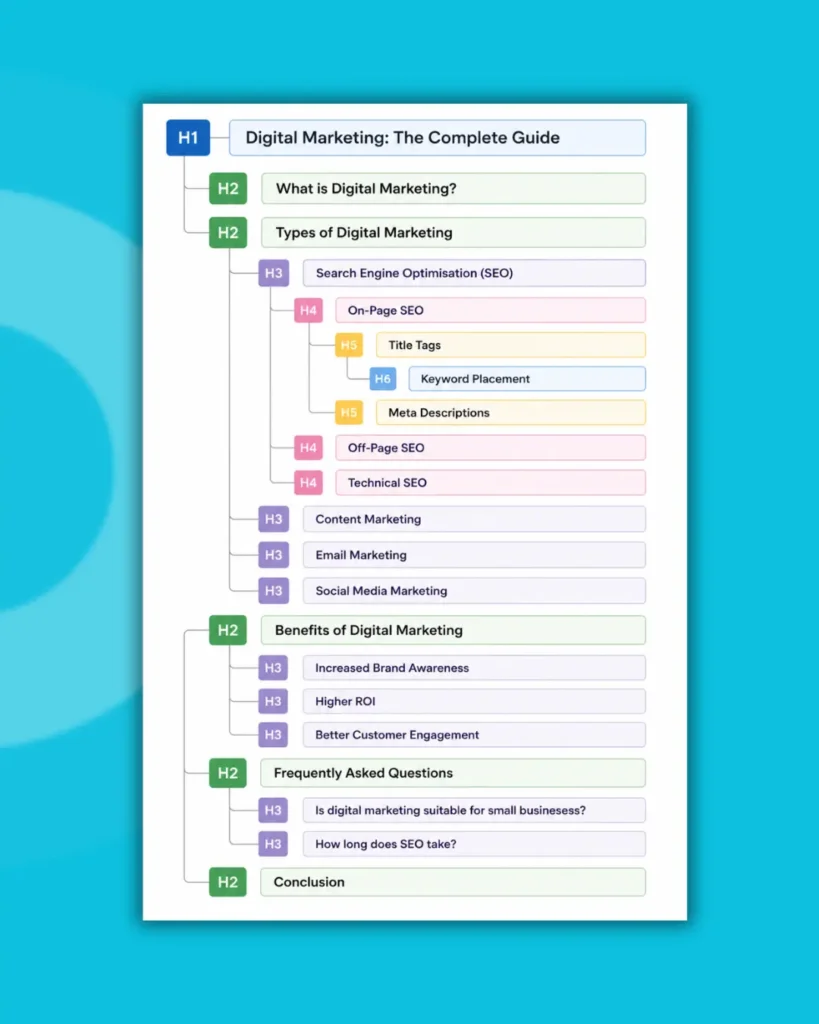
Step 6. Write an Engaging content
- Create working Headline: As you begin your writing, try to have a heading that is attractive, clear and descriptive. A strong SEO headline conveys what your post will cover and sets clear expectations for the reader about what they’ll gain.
- Simple Tips to writing a good content heading:
- Use Clear and simple language
- Always include your primary keyword
- Communicate the benefits of your article
- Your Title should be H1 tag
- Be accurate and direct
- Simple Tips to writing a good content heading:
- Write your Introduction: Your introduction sets the tone for how the remaining part of the content will be. It should be smart, informative and attractive. A good introduction must contain a compelling hook to grab attention, a transition that addresses the reader’s pain points, and a promise/thesis that outlines the value and solutions the article will deliver.
- Best Practice:
- Keep it brief
- Skip the fluff
- Talk directly to the reader
- Best Practice:
- Write Your Body Content: The body content is the heart of your blog post. It explains your topic, answers your readers’ questions, and helps search engines understand what your content is about. A well-written body keeps visitors engaged, encourages them to continue reading, and increases the chances of ranking higher in search results.
Begin each section by introducing the main idea clearly. Don’t make readers search for the answer. Explain the key point first, then provide supporting details, examples, statistics, or practical advice.
Break your article into logical sections using headings and subheadings. This makes your content easier to read and helps search engines understand your page structure.- A typical structure looks like this:
- Main topic
- Explanation
- Benefits
- Step-by-step guide
- Common mistakes
- Best practices
- Frequently asked questions
Each section should focus on one idea before moving to the next.
- Explanation
- Main topic
- Add images: It is a good idea to have some sort of imagery within it that compliments your article. It actually helps to have catching visuals that matches the subjects of discuss because it keeps the readers engaged. Try to have some. at least one image within your blog post.
- Pro Tips to enhancing your body content:
- Write Short, Readable Paragraphs
- Explain Your Concepts in a simple and easy manner
- Support Your Points with: Real-world examples, Statistics, Research findings, Case studies, Expert quotes, Personal experience, and Practical scenarios
- Use Lists When Appropriate
- Include Visual Breaks like: Images, Charts, Tables, Infographics, Screenshots, Videos, Pull, and quotes
- Naturally Include Your Keywords
- Keep Each Section Focused
- Link to Related Articles
- Write Naturally and End Each Section Smoothly
- A typical structure looks like this:
- Write an Engaging Conclusion: For the conclusion, tell readers what to do next.
Step 7. Optimize for SEO
Here’s where strategy comes in. When it comes to optimizing your blog post for SEO, it has to be done smartly. Optimizing your post for search engines helps it reach a wider audience. This process starts by keyword research and naturally placing your keywords within the content, headings, meta descriptions, and alt text for image optimization. I recommend understanding the Beginner’s Guide to Search Engine Optimization.
Step 8. Review and Edit your content
Always take your time to review and make changes to your content before publishing. This will help you spot errors you didn’t quite see during writing and also to improve the general arrangement and positioning and flow of your blog post
I recommend:
- Factcheck the information you have put together.
- Use tools to review your spelling, punctuations, and grammars. This helps to keep your articles from errors. You might also consider using AI tools like ChatGPT to get a second opinion on your draft, Hemingway to make your writing concise
- Reading your article out loud.
- Share your article to a few friends or family member to proofread
Step 9. Publish Your Blog Post
Now it’s time to publish the blog post via your content management system (CMS) or blogging platform to make it accessible to readers. But before you do, use the live preview feature to make sure everything looks as it should. also, double-check that you’ve added the Alt text to the images, use the right URL slug, Title tag, Meta discription etc.
Step 10. Share Your Blog Post
The last and maybe not the final process is no share and promote your blog post through other marketing channels like social media( Facebook, Instagram, LinkedIn, etc.), Email, paid channels, content syndication and outreach – to help reach many readers. This process is called content distribution.
A Quick Summary of My Process
Here’s a quick recap of my blog post writing process from start to finish:
- Brainstorm Blog Topic Idea and Pick
- Perform keyword research
- Think of your reader
- Start your research
- Create an outline
- Write an Engaging content
- Optimize for SEO
- Review and Edit your content
- Publish Your Blog Post
- Share Your Blog Post
Conclusion
That’s my workflow. Blog post writing process doesn’t have to be complex. With the steps listed above and little tips, you can write a successful blog post. Feel free to try new style and patterns. Remember to feel free to copy my workflow and be flexible
If there’s an aspect of writing a blog post that I didn’t cover, or you have specific questions about my process or anything generally blog-related, let me know in the comments – I’ll answer them as best I can.
