How to Write a Lean Business Plan | Lean Business Plan Template
Starting a business can feel overwhelming. You juggle ideas, funding, customers, and operations all at once. If you write a 40-page traditional plan, you may spend months planning instead of launching. That delay costs you time, money, and momentum.
If you want clarity without complexity, you need to learn how to write a lean business plan. A lean plan helps you focus on what truly matters: your customers, your offer, your revenue, and your next steps. You can build one in 60 to 90 minutes and start testing your idea immediately.
In this guide, I will show you exactly how to create one, when to use it, and how to turn it into a powerful growth tool.
Lets begin with
What is a Lean Business Plan?
A lean business plan is a short, focused document that outlines the core parts of your business. Instead of writing 20 to 50 pages, you summarise your strategy in 1 to 5 pages.
In the lean business plan, You only concentrate and define:
- Your target customer
- The problem you solve
- Your solution
- Revenue streams
- Key costs
- Metrics
- Milestones
- Assumptions and risks
You review and update this plan monthly or quarterly. You use it as a working document, not a file that gathers dust.
When I work with founders, I see one clear pattern: those who use lean planning make faster decisions, test ideas earlier, and adapt with confidence.
Difference Between a Traditional Business Plan and a Lean Business Plan
You may wonder whether you still need a traditional business plan. Let’s break it down.
| Feature | Traditional Business Plan | Lean Business Plan |
|---|---|---|
| Length | 20–50+ pages | 1–5 pages |
| Purpose | Secure funding, convince stakeholders | Guide operations, enable quick adjustments |
| Detail Level | In-depth research and projections | Core assumptions, metrics, and milestones |
| Update Cycle | Yearly or during major events | Monthly or quarterly |
When you learn how to write a lean business plan, you shift your focus from paperwork to execution. You still can expand it later if investors request more detail. But you begin with clarity and evidence.
Read also: Steps on How to Conduct Effective Market Research
Benefits of a Lean Business Plan
- Accelerated Launch Speed: Creating a lean plan allows new ventures to start operating within weeks instead of months.
- Enhanced Focus and Prioritization: By constraining your plan to 1-2 pages, you naturally eliminate non-essential activities and concentrate resources on what genuinely moves the needle.
- Simplified Team Alignment: Monthly check-ins where teams review lean plan milestones and adjust tactics based on metrics create cohesive direction. Everyone understands the current priorities, key performance indicators being tracked, and how their work contributes to broader goals.
- Resource Efficiency: Lean planning redirects many hours toward actual business-building activities. The time saved compounds, you’re not just writing less, you’re testing assumptions faster, gathering real market feedback sooner, and iterating more frequently.
- Adaptability to Change: Market conditions shift rapidly. Customer preferences evolve. Competitors launch new products. A lean business plan’s monthly or quarterly revision cycle means you’re never more than a few weeks from reassessing and adjusting your approach. This responsiveness transforms planning from a once-yearly exercise into an ongoing strategic process.
When Should You Write Your Lean Business Plan?
You should create a lean plan if you:
- Plan to launch a startup
- Want to validate a new idea
- Prepare to build your MVP
- Add a new product or service
- Pivot your business model
- Prepare for investor conversations
- Review your strategy quarterly
Before you invest serious money, write your lean plan first. It helps you test before you commit.
Read also: How to Write a Professional Business Plan That Gets Funding Quickly
How to Write a Lean Business Plan
Now let’s walk through the practical steps.
Step 1: Set Your Objective and Time Limit
Start by defining what you want to achieve in the next three to six months. Ask yourself what success looks like and what problem you aim to solve. Set a 60 to 90 minute time limit for your planning session. This forces you to focus and prevents overthinking.
Before you begin writing, gather basic information such as customer insights, pricing data, cost estimates, and any previous performance metrics. Do not over-research. You can refine your assumptions later through testing.
Step 2: Define Your Value Proposition and Target Customer
Clearly describe who you serve and the problem you solve. A simple framework helps:
We help [target customer] who struggle with [specific problem] by offering [solution] so they can [main benefit].
Be specific about your target audience. Define their industry, company size, behaviour patterns, and key frustrations. When you narrow your focus, you increase your chances of attracting the right customers.
Step 3: Outline Your Products, Marketing, and Operations
Describe what you sell and how you price it. Then explain how you plan to attract and convert customers. Focus on one or two primary marketing channels instead of spreading yourself too thin.
Common marketing channels include:
- SEO and content marketing
- LinkedIn organic content
- Email marketing
- Paid advertising
- Strategic partnerships
Clarify how customers will buy from you. Will they book a call, start a free trial, or purchase directly online? Also define who handles sales, support, and operations. Keep it simple and practical.
Step 4: Define Metrics and Milestones
You must track measurable indicators of progress. Choose three to five key metrics that reflect business health. These often include:
- Monthly recurring revenue
- Customer acquisition cost
- Conversion rate
- Retention or churn rate
- Net profit
Set clear milestones for the next three months. For example, you might aim to launch your beta in month one, reach £5,000 in monthly revenue by month two, and hire part-time support by month three. Assign responsibility for each milestone so everyone understands their role.
Step 5: Add Financial Essentials
Include realistic revenue targets and major cost categories. You do not need complex spreadsheets at this stage. Provide clear monthly estimates for revenue streams and expenses such as software, marketing, salaries, and contractors. These figures help you evaluate sustainability and cash flow early.
Step 6: Document Assumptions and Risks
Every business idea relies on assumptions. Write them down openly. For example, you might assume that customers will pay £29 per month for your product. Identify the associated risk and define how you will test it. You might pre-sell to ten prospects before building the full solution. When you document risks clearly, you reduce uncertainty and make better decisions.
Step 7: Establish Your Review and Iteration Process
Your lean business plan only works if you review it consistently. Schedule a monthly 60-minute review session. During that session, compare your actual results with your projected milestones. Identify what works and remove what does not. Adjust your strategy based on data from sales performance, website analytics, customer feedback, and support requests.
This review cycle turns your lean business plan into a living growth system rather than a static document.
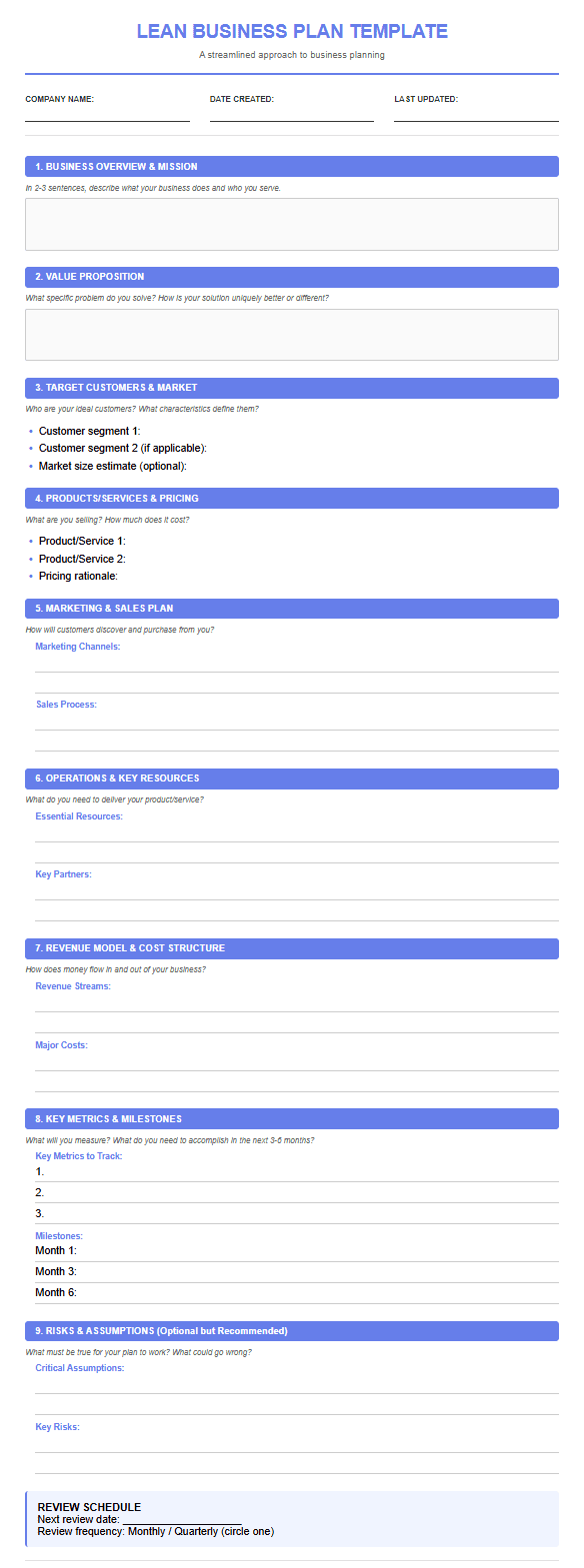
Lean Business Plan Template
Use the template below as a guide to creating your own Lean Business Plan
Conclusion
Now you understand how to write a lean business plan that drives action instead of paperwork. You do not need complexity to build a successful business. You need focus, accountability, and regular review.
Set a timer today. Draft your lean business plan in 90 minutes. Then move from planning to execution with confidence.